
The Last Porch Light by Jesse Cole Beckett on Screen
The Last Porch Light by Jesse Cole Beckett doesn’t sound built for montage. Its acoustic grain, slide-steel ache, and warm baritone belong to the moments after the plot breaks open: a truck leaving town, a kitchen confession, a final shot that refuses easy redemption.
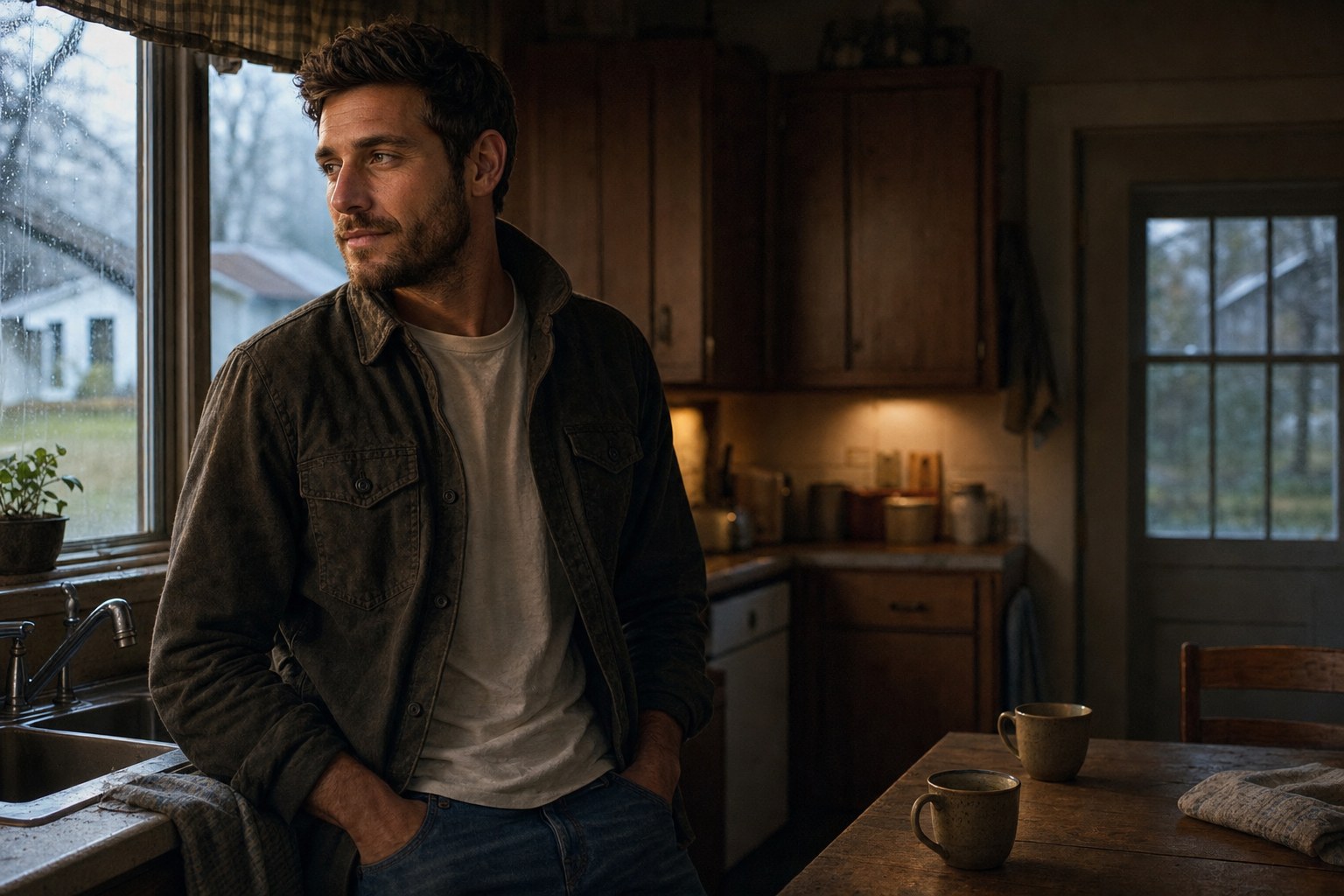
The Last Porch Light is most useful on screen when a character has run out of explanations. Jesse Cole Beckett’s debut album carries the tension of a modern outlaw country soundtrack, but its real strength is quieter: these songs understand the aftermath.
The Last Porch Light belongs in four kinds of scenes: the opening escape of Hell or High Water (2016), the domestic fracture of Friday Night Lights (2006–2011), the morally bruised road film Mud (2012), and the closing credits of The Rider (2017). Released May 8, 2026, the sixteen-track album supplies acoustic guitars, slide steel, Telecaster bite, brushed drums, and church-piano lift without flattening those scenes into sentiment.
Jesse Cole Beckett’s music arrives from the same broad lineage as Sturgill Simpson, Tyler Childers, Colter Wall, Jason Isbell, Willie Nelson, and Chris Stapleton, but the sync question is more exact than influence mapping. A song works on screen when its arrangement leaves room for an image to change meaning. Beckett’s production respects that space.
The album’s title gives away its governing image: not the road itself, but the small light waiting after the road has done its damage. That makes The Last Porch Light a strong candidate for country sync music built around consequence rather than spectacle.
The Last Porch Light and the neo-western exit
“Good Trouble” belongs over the first ten minutes of Hell or High Water, especially a sequence of stolen trucks, empty frontage roads, and motel doors closing behind men who know the plan is already compromised. The May 5, 2026 lead single has the right title-level ambiguity: trouble as recklessness, loyalty, and the last available form of agency.
The track’s placement would work best without a full-volume chorus at the outset. Beckett’s conversational baritone can sit beneath engine noise and wide Texas horizons, while acoustic guitar establishes forward motion and Telecaster bite supplies the image’s harder edge. That contrast recalls the way Hell or High Water uses country and folk textures without turning poverty into scenery.
A sync supervisor could also place “Good Trouble” beneath a character making the wrong decision for the right person. The song’s outlaw country soundtrack value comes from that unresolved moral temperature: it doesn’t announce whether the road leads to freedom or merely postpones judgment.
Jesse Cole Beckett’s songs don’t score the escape; they score the cost of needing one.
From family drama to the Americana soundtrack
“Hallelujah Anyway” belongs in Friday Night Lights after a family argument, when the room is still full of people but nobody has found language for what happened. The song’s title places grace beside exhaustion, matching the series’ instinct for emotional resolution that arrives as a gesture rather than a speech.
The arrangement matters here. Church-piano lift can widen a kitchen or hallway without making the scene feel sanctified, while brushed drums keep the pulse human and unforced. Beckett’s warm baritone would hold the center between Sturgill Simpson’s hard-won transcendence on 2014’s Metamodern Sounds in Country Music and Jason Isbell’s close-miked domestic realism.
“Hallelujah Anyway” also fits the final act of a family drama in which forgiveness is partial. The song should enter after the decisive line, not before it. Its job is to let the audience sit with the imperfect repair, which is exactly where Beckett’s modern outlaw country becomes more than genre styling.
“Two Headstones” belongs in Mud, during a river-road passage where a young character starts to understand that adult devotion and adult damage can be the same thing. The title carries an immediate visual architecture: two graves, two versions of a promise, or two people whose lives have become inseparable from loss.
Slide steel would give that sequence a horizon without romanticizing it. The instrument’s sustained tone can stretch across water, rusted machinery, or a character watching a boat disappear, while brushed drums keep the scene from becoming a music-video lament. This is cinematic country in the precise sense: a small harmonic and timbral movement changes the size of the frame.
The pairing also reflects the film’s resistance to clean mythmaking. Colter Wall’s 2015 self-titled record often treats landscape as a witness rather than a refuge; “Two Headstones” can perform a similar function on screen. It doesn’t tell the viewer who deserves sympathy. It gives the image enough weather to remain complicated.
The closing-credit weight of The Last Porch Light
“Saturday Night Salvation” belongs over the closing credits of The Rider, after the film has exhausted its obvious language for masculinity, work, and bodily limitation. The title joins a barroom impulse to a church vocabulary, and that collision mirrors a film where identity survives by changing shape rather than returning to an old self.
The track should begin before the credits fully arrive, under a final image that still has room around it. Acoustic guitar can preserve the intimacy of the preceding scene, while a growling baritone and slide steel let the emotional frame expand without resorting to orchestral uplift. That restraint is the difference between an Americana soundtrack and generic roots signification.
The Last Porch Light’s sixteen-track length gives a supervisor several shades of the same emotional world, but “Saturday Night Salvation” has the clearest end-credit function. It carries release without claiming victory. The song leaves a character standing, not redeemed by arrangement.
Best screen placements for Jesse Cole Beckett
- “Good Trouble” — the opening escape or failed getaway in a neo-western such as *Hell or High Water*.
- “Hallelujah Anyway” — the quiet aftermath of a family argument in a serialized drama such as *Friday Night Lights*.
- “Two Headstones” — a river-road reckoning in the morally unsettled world of *Mud*.
- “Saturday Night Salvation” — closing credits after an identity has changed, as in *The Rider*.
The strongest placement for Jesse Cole Beckett isn’t a bar fight, a boot-stomp montage, or a wide shot of a truck crossing a ridge. It’s the scene after those familiar images have lost their power. The Last Porch Light works on screen because its country is already looking past the legend, toward the person who still has to come home.