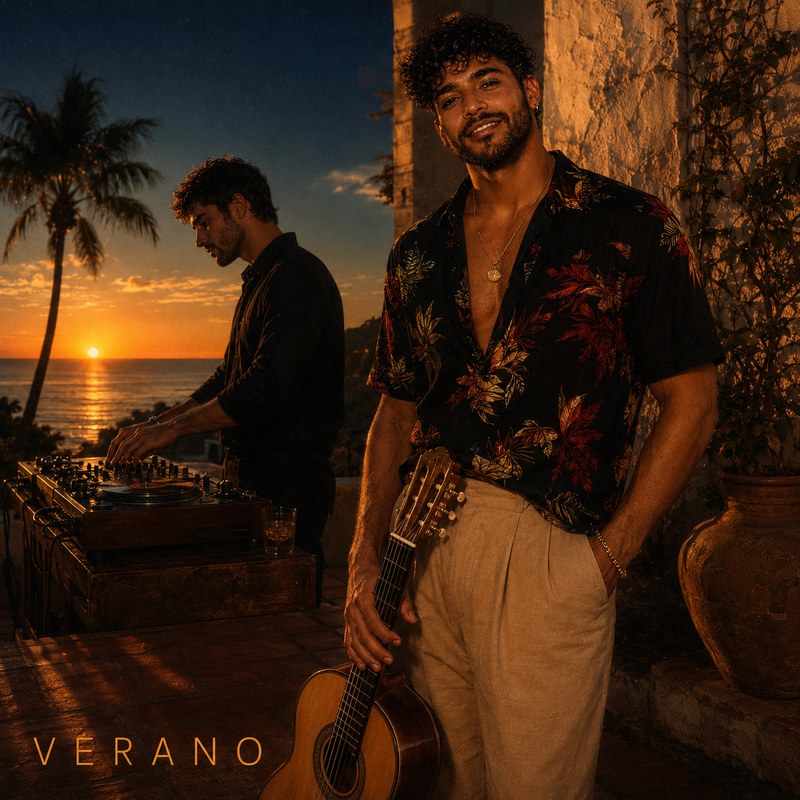
Santiago Fuego
Latin artist bringing Caribbean heat to the global dancefloor. Dembow rhythm, tropical percussion, Spanish-first lyrics with an unmistakable accent.
Released on McCandless Records, 2026.
Santiago Fuego is a Latin artist whose music carries the heat of the Caribbean and the swagger of the modern global dancefloor. Reggaeton sits at the spine — dembow rhythm, melodic bass, tropical percussion — but the sound stretches into Latin pop, tropical house, dembow, and salsa fusion without ever leaving the family. His voice is a smooth tenor, equally at home on a melodic hook or a rhythmic flow, with clean Spanish articulation and an unmistakable Caribbean accent.
His debut album, Paraíso, is an eighteen-track journey across love, desire, and celebration, anchored entirely in Spanish lyricism. From the rooftop energy of Vamos and Dale to the slow-burn romance of Caliente and Heaven, to the late-night fire of La Noche and the title track itself, Paraíso plays like one long perfect day — beach at noon, rooftop at sunset, fiesta at midnight, balcony at dawn.
The musical DNA pulls from Bad Bunny, Daddy Yankee, J Balvin, Rauw Alejandro, and Juan Luis Guerra. Paraíso released on May 5, 2026, preceded by the lead single Vamos on May 2.

The single Vamos (May 2, 2026) and the eighteen-track full-length album Paraíso (May 5), plus a feature on Nova Driftwood's "Verano" (May 22).
Santiago Fuego is available on every major streaming service. Pick yours.
Paraíso by Santiago Fuego sounds sunlit, but its real architecture is subterranean: kick, sub-bass, and clipped vocal doubles create a dancefloor engine beneath the album’s tropical color. Across eighteen tracks, the production makes restraint feel physical.
Modern reggaeton 2026 isn't defined by a single drum pattern or a Puerto Rican throwback. Santiago Fuego's Paraíso shows how the genre now absorbs tropical house, salsa phrasing, and Latin pop without softening the pressure of the dembow.
Paraíso by Santiago Fuego treats dembow less like a fixed beat than a movable climate. Across eighteen tracks, the rhythm stays recognizable while bass, percussion, melody, and vocal phrasing shift the record from rooftop invitation to late-night confession.
Santiago Fuego Paraíso doesn’t arrive as a single-club record. Its eighteen tracks move from rooftop dembow to balcony-after-midnight romance, so the best preparation is a short map of reggaeton’s melodic, tropical, and street-level lineages.
Santiago Fuego Paraíso sounds less like a collection of singles than a film already waiting for its edit: rooftop flirtation, sunstruck travel, a midnight chase, and the quiet after the party. Its eighteen Spanish-language tracks give music supervisors clean emotional cues without sanding away the Caribbean accent.
Santiago Fuego Paraíso is a debut that stages reggaeton as ritual rather than soundtrack — an eighteen-track sequence that maps a single party-day from noon to dawn. Paraíso folds dembow, salsa syncopation and tempered tropical-house production into an intimate Spanish-first narrative.