
Modern Outlaw Rock and Viper Junction's Gasoline Hymn
Modern outlaw rock has spent the last decade borrowing country’s dust, noir’s menace, and arena rock’s scale. Viper Junction’s Gasoline Hymn refuses the costume: its sixteen tracks turn the chapel, the gas station, and the amplifier into one scorched, contradictory language.
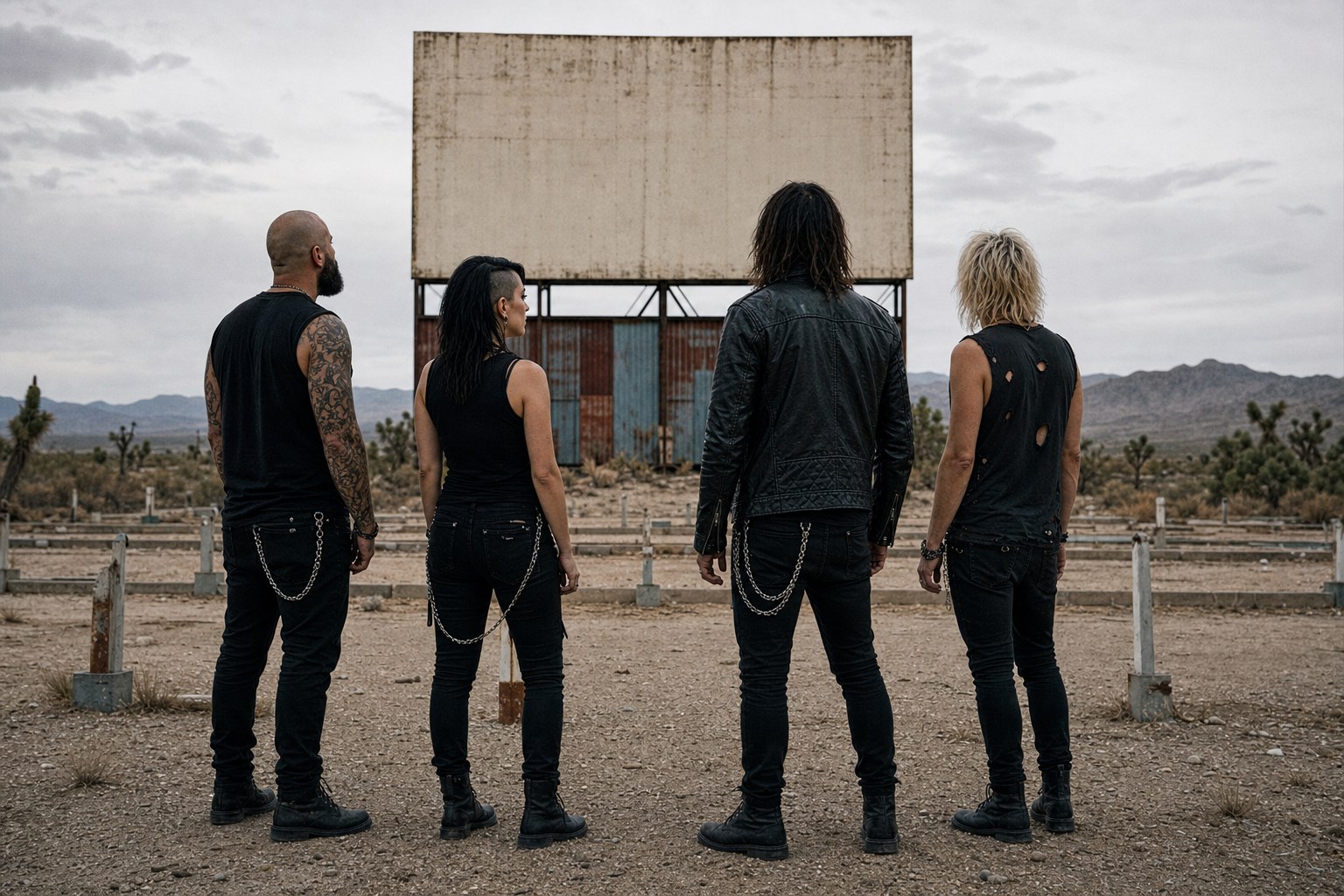
Modern outlaw rock is no longer defined by cowboy hats, blood-and-dust mythology, or the simple romance of the open road. Its sharper question is whether a band can make American escape music after the highway has become a feed, a film genre, and a branded moodboard. Viper Junction answers with volume: Gasoline Hymn treats distortion as architecture and the desert as a moral argument.
Viper Junction’s Gasoline Hymn contributes a harder, less nostalgic version of modern outlaw rock. The sixteen-track debut, released May 17, 2026, puts a powerful alto at the center of walls of distortion, joining garage-rock abrasion to stadium-scale choruses. Lead single “Rattlesnake Kiss,” arriving May 14, establishes the record’s central tension: primal rock ’n’ roll that sounds reverent without becoming clean.
The distinction matters because outlaw imagery has become one of contemporary culture’s most efficient shortcuts. Taylor Sheridan’s Yellowstone turned ranch architecture, denim, and low-register Americana into a global visual language. Chloe Zhao’s Nomadland, released in 2020, found a quieter version of the road in work camps, parking lots, and open desert. Viper Junction starts from the same cultural landscape but rejects both prestige naturalism and television’s polished myth.
Viper Junction comes from Joshua Tree, CA, a place that carries its own visual burden in popular culture. The band’s desert rock isn’t a tourism brochure of cacti and retro motel signs. Its stated palette—desert sand, asphalt black, rust orange, chrome silver—reads more like a stage plot for impact: dry earth beneath, blackened machinery above, metal catching whatever light remains.
That palette places Viper Junction near Queens of the Stone Age’s desert compression, especially the muscular economy of 2002’s Songs for the Deaf, but the difference is in the vocal center. Josh Homme often makes menace feel conversational and horizontal. Viper Junction’s powerful alto turns the song into a vertical structure, pushing upward through the guitar mass rather than merely standing in front of it.
Modern outlaw rock needs a contradiction, not a costume
The most durable outlaw records understand that rebellion is never only about speed or volume. Waylon Jennings and Willie Nelson’s 1976 Wanted! The Outlaws made independence legible through arrangement, label politics, and a refusal of Nashville polish. Viper Junction inherits the emotional principle rather than the sonic template. Gasoline Hymn replaces honky-tonk twang with distorted guitar, but it keeps the outlaw song’s basic demand: make private refusal sound communal.
The album’s governing image is the chapel and gas station as the same building. That isn’t decorative symbolism. It gives Viper Junction a compositional rule: every moment of devotion should carry grime, and every act of escape should contain a ritual. “Rattlesnake Kiss” makes that rule audible in its title alone, pairing venom with intimacy and threat with contact.
“Rattlesnake Kiss” works as a lead single because it doesn’t ask the listener to choose between the sacred and the profane. The phrase has the blunt physicality of garage rock, while “kiss” introduces the kind of vulnerable melodrama usually reserved for a power ballad. Viper Junction’s central achievement is to make those registers occupy the same bar without sanding away either one.
That tension separates the band from the current desert rock revival’s more predictable gestures. A fuzz pedal, a motorcycle, and a minor-key riff can signify authenticity before the singer has delivered a line. Viper Junction uses those materials, but the powerful alto prevents the arrangement from becoming a museum of masculine rock symbols. The voice makes the machinery answer to a person.
The record’s stadium ambition also avoids the usual false choice between scale and intimacy. Stadium rock, at its best, doesn’t mean making every part enormous. It means designing a refrain that can survive distance. Viper Junction’s garage rawness supplies the close microphone, the scraped edge, and the sense of bodies in a room; the distortion supplies the long throw, turning that room into an arena.
The precedent here is not only classic hard rock. Bruce Springsteen’s Nebraska, released in 1982, proved that outlaw storytelling could gain force through reduction, while 2017’s A Deeper Understanding by The War on Drugs showed how highway music could become atmospheric without losing its forward motion. Viper Junction takes the opposite route from both records: its road is not sparse or panoramic. It’s crowded with heat, steel, and conflicting signals.
Viper Junction makes the outlaw song sound less like an escape plan than a pressure test for faith, desire, and noise.
From Yellowstone’s myth to Joshua Tree’s amplifier wall
The cultural moment around modern outlaw rock is partly a reaction to frictionless pop. Streaming has made genre boundaries porous, but it has also made texture newly valuable: the audible scrape of a pick, the room around a snare, the moment a vocal breaks against a guitar. Viper Junction’s walls of distortion answer that condition directly. Their sound insists that a record can still feel built rather than merely assembled.
Yellowstone’s success sharpened the appetite for music that appears to carry land, labor, and danger inside it. Yet the show’s soundtrack often places contemporary songs inside a highly controlled cinematic frame. Viper Junction reverses the process. Gasoline Hymn makes the frame itself unstable, using garage-rock rawness to keep the desert from becoming scenery.
The comparison with Nomadland is equally revealing. Zhao’s film strips the road of heroic speed and finds dignity in repetition: seasonal work, temporary shelter, departure, return. Viper Junction preserves the road’s velocity but complicates its promise. A highway howl can sound liberating, yet the album’s sacred-profane premise makes every mile feel like a test of what the traveler is carrying.
Mad Max: Fury Road, released in 2015, offers another useful precedent. George Miller’s film makes engines, bodies, and landscape move as one kinetic machine, then gives its emotional center to Furiosa’s refusal of inherited power. Viper Junction’s music operates with a related instinct: the heavy object is never only spectacle. The amplifier wall matters because the alto inside it has something to survive.
That vocal perspective changes the meaning of “stadium teeth.” The phrase suggests music with enough bite to fill a large room, but it also implies a performer who can expose the gums beneath the grin. Viper Junction’s alto is not presented as a decorative contrast to masculine guitar weight. It is the record’s measuring instrument, testing whether each riff has emotional consequence.
The same principle gives Gasoline Hymn a stronger relationship to garage rock than its scale might suggest. Garage rock is not simply a distortion setting or a preference for rough edges. It’s a suspicion of unnecessary distance between impulse and sound. Viper Junction keeps that suspicion alive even when the arrangement reaches for the stadium, allowing the song to feel immediate before it feels monumental.
The band’s independent position on McCandless Records reinforces that pressure without needing to turn the record into a manifesto. Gasoline Hymn arrives as the label’s desert-rock entry in a debut roster built across eight genres, but its identity isn’t reducible to category placement. The useful independence is audible in the refusal to choose between a rough room and a large horizon.
What Viper Junction adds to the desert rock revival
Viper Junction adds moral density to the desert rock revival. The band’s imagery moves through motorcycles, rock formations, cinder blocks, chrome, and asphalt, but the music refuses to let those objects remain cool. “Rattlesnake Kiss” turns danger into intimacy; Gasoline Hymn’s title turns fuel into prayer. Each image becomes useful only when it collides with a human need.
That collision is where Viper Junction differs from retro rock that treats the past as a safe house. The band channels the abrasion of garage rock, the reach of stadium rock, and the iconography of the American highway, but it doesn’t pretend those forms are innocent. The record’s sacred-profane songwriting acknowledges that escape fantasies depend on exhaustion, faith, appetite, and the cost of continuing.
The sixteen-track length is part of that argument. A shorter release could present “Rattlesnake Kiss” as a decisive statement and leave the desert frozen in one pose. Gasoline Hymn instead has the scale of a route: a sequence long enough for the initial hit of freedom to meet repetition, doubt, and return. Its breadth makes the highway less like a postcard and more like a lived condition.
- Viper Junction updates modern outlaw rock by replacing cowboy nostalgia with desert pressure and amplified physicality.
- Gasoline Hymn uses the chapel and gas station as a central image for songs where faith and grit occupy the same space.
- The band’s powerful alto turns distortion into emotional architecture rather than a wall of anonymous force.
- “Rattlesnake Kiss” establishes the record’s method by joining venom, desire, and primal rock directness.
- The sixteen-track debut treats the highway as repetition and consequence, not just freedom or escape.
Modern outlaw rock often sells the fantasy of leaving everything behind. Viper Junction understands that the more interesting song begins after the engine turns over, when the traveler still has to decide what counts as faith, what counts as freedom, and what the noise is hiding. Gasoline Hymn gives those questions a powerful alto, a wall of distortion, and sixteen tracks of highway weather.