
Gasoline Hymn production: how Viper Junction built their desert walls
Gasoline Hymn production announces Viper Junction's debut as a studio manifesto: sixteen tracks that make distortion feel architectural. The record's studio choices—mic'd amp stacks, a roomy live drum capture, and a tape-forward vocal chain—turn desert grit into a stadium-ready thrust without losing garage immediacy.
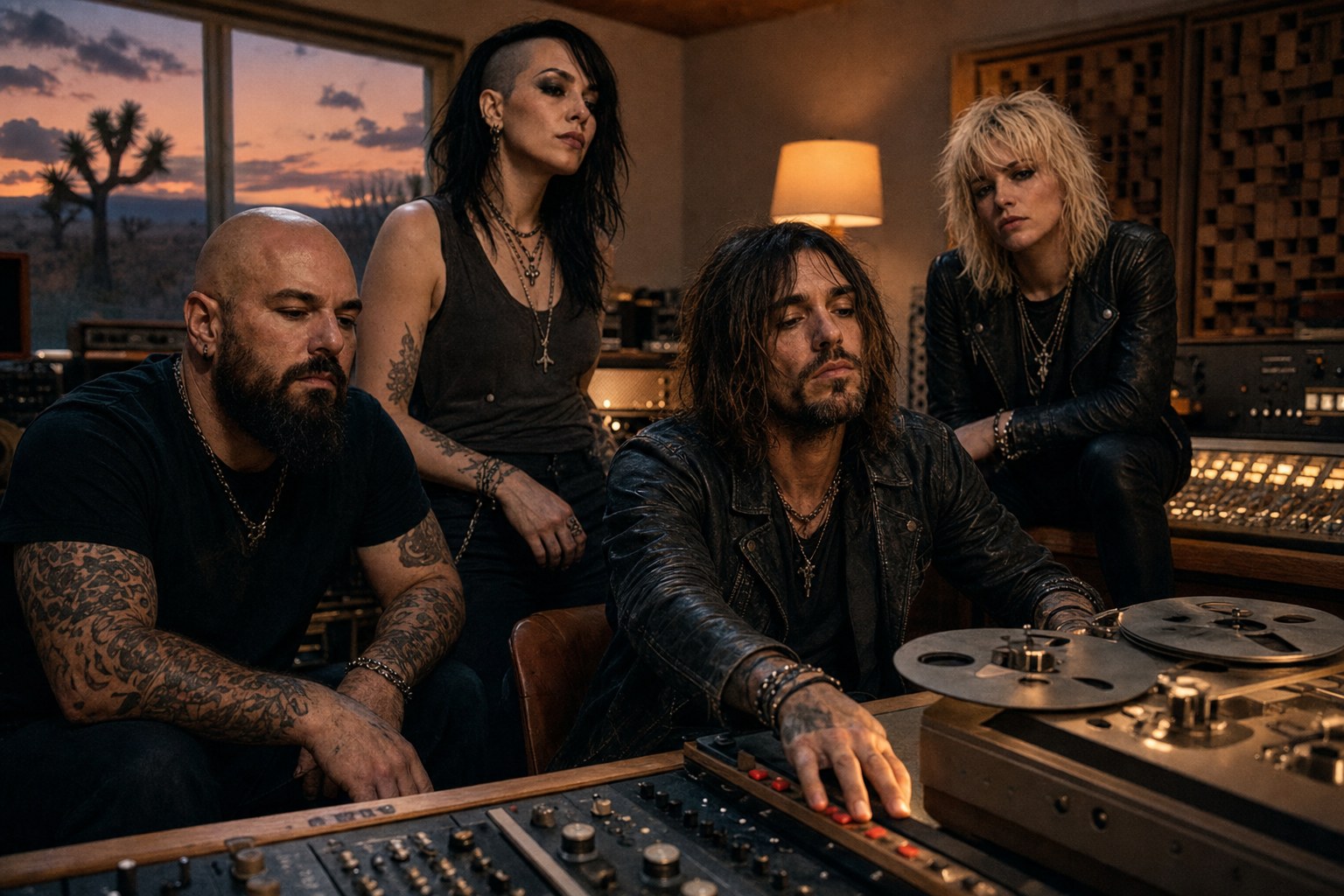
Viper Junction's Gasoline Hymn production centers on three deliberate studio choices: multi-miked tube-amp stacks blended with room bleed, a live-room drum capture that preserves cymbal wash and transient snap, and alto vocal tracking through a vintage large-diaphragm condenser into tape saturation and plate reverb. The record is sixteen tracks long and releases May 17, 2026; the lead single "Rattlesnake Kiss" drops May 14.
Viper Junction recorded Gasoline Hymn in a compact Joshua Tree live room designed for natural ambience rather than isolation. The band tracked rhythm sections live on songs like "Rattlesnake Kiss" at tempos between 92–110 BPM so the room's decay sits rhythmically under the kick and snare. That decision makes the drums feel both immediate and cathedral-sized without artificial reverb patches.
Gasoline Hymn production: amps, mics, and the sand-in-the-gear tone
Viper Junction placed guitar cabinets in two- to three-amp stacks—Marshall Plexi-style heads for midrange bite, a Fender Twin for top-end chime, and a Mesa/Boogie for low-end grunt—then recorded each cabinet with a tight SM57 on the cone and a ribbon 2–4 feet back as a room reference. That mic pairing preserves the SM57's midrange shove while the ribbon's roll-off softens glassy highs, creating the "desert wall" guitar sound heard on "Broken Highway".
Viper Junction dialed preamp coloration intentionally: guitar signals hit an API-style 512 on one pass and a Neve 1073 on the double-tracked takes, then were summed at mixdown. The API tracked the attack and upper-mid aggression; the Neve added harmonic heft around 200–500 Hz. The result is a dual-character tone—one mic for attack, one for body—that survives heavy distortion without turning muddy.
Viper Junction routed key guitar busses through an EMT-style plate emulation and a small Fender spring in parallel during the mix of "Chapel & Pump". The plate sits at 600–1,200 ms decay for a sustained swell under choruses, while the spring is set tight with pre-delay under 30 ms to keep the tremor audible on single-note fills. That combination reads as both sacred and metallic—literal chapel bells inside a gas station amplifier.
Viper Junction treated bass on Gasoline Hymn as a hybrid of DI and amp. The band recorded an Ampeg SVT head miked with an Electro-Voice RE20 and blended that with a clean DI fed to an 1176-style compressor. The miked amp provides grit and room coupling at 60–120 Hz, while the DI keeps the low fundamental clear through dense guitar layers—especially notable on "Last Light at Mile Marker 7" where the low end locks to a 1/8-note pulse.
Viper Junction captured drums with a 12–16 mic configuration that emphasized room tone: kick with an AKG D112 inside and a low-pass gated SM7 outside, snare top with an SM57 and bottom with a small-diaphragm condenser, and Coles-style ribbon overheads for cymbal bloom. The room pair sat two meters back and was intentionally audible; on "Rattlesnake Kiss" you can hear the room's 160–300 ms tail giving the chorus its open, anthemic push.
Viper Junction used compression as shaping rather than squashing. The band placed a slow-attack, fast-release bus compressor (LA-2A coloration married with an SSL bus glue) across drums to preserve transient snap while warming the sustain. On dynamic crescendos the mix bus settles with 3–4 dB of gain reduction, retaining headroom for vocal peaks and guitar harmonics.
They built stadium heft from small-room performances: close mics for attack, distant mics for scale, and tape saturation to make both live in the same space.
Vocal chain and the alto that sits between chapel and highway
Viper Junction tracked the alto vocal with a vintage large-diaphragm condenser—an archetypal U47-style tone—through a Neve 1073 preamp into a two-inch tape machine emulation. The chain uses LA-2A compression for smooth level control and a short plate reverb for presence. On "Rattlesnake Kiss" the vocal sits forward at roughly -6 dB relative to the guitars in the verse and climbs into a saturated, hymn-like chorus.
Viper Junction doubled crucial vocal lines and slightly detuned the doubles to create a chorusing thickness without digital chorus plugins. The doubles were panned and treated with different EQ curves—one brighter at 3–6 kHz, one darker around 400–800 Hz—so the alto maintains clarity over the guitar wall. That manual doubling is a big part of the record's alto vocal treatment.
Viper Junction leaned on tape saturation and analog summing to glue instruments. The band allowed 2–5 dB of harmonic distortion from tape emulation on guitars and vocals, which fattens the midband and helps the mix translate to loud PA systems. Mastering aimed for preserved dynamics rather than maximal LUFS; the album feels loud in performance but retains 6–8 dB of crest factor compared with heavily brickwalled rock masters.
Three takeaways for producers chasing desert rock production
- Record rhythm sections live and keep some bleed—Viper Junction's live-room drums give chorus sections natural scale.
- Use dual amp/mic characters—pairing an API-flavored attack mic with a Neve-bodied take preserves clarity under distortion.
- Favor analog coloration over heavy plug‑in reverb—plate + spring emulation plus tape saturation creates a tactile, stadium-ready sheen.
Viper Junction's Gasoline Hymn production trades studio polish for architectural roughness: each technical choice aims to make the desert feel like an instrument. Guitar amp tone, room mic placement, and a tape-forward vocal chain transform garage immediacy into hymn-sized dynamics, and the record proves you don't need pristine isolation to build a stadium sound.