
GLITCH by Prism Five: Where K-Pop Belongs on Screen
GLITCH by Prism Five isn't background music for a scene; it behaves like a scene change. The seventeen-track debut moves from synchronized impact to vocal intimacy, giving sync supervisors a rare K-pop record that can score a chase, a fashion montage, or the instant a polished world starts to fracture.
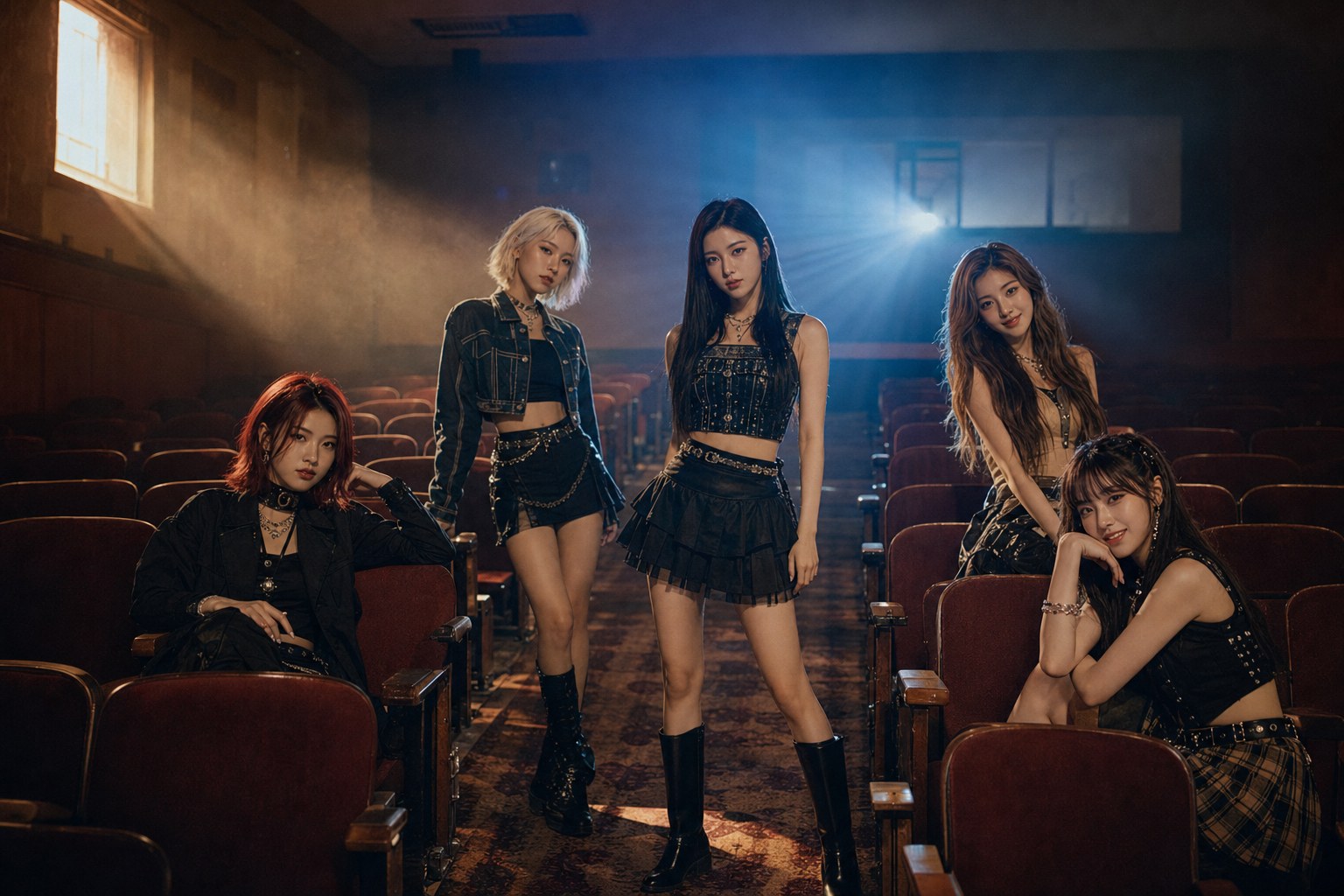
GLITCH by Prism Five belongs on screen precisely because it refuses to stay in one register. The Seoul group’s debut is built for choreography, but its five voices and electronic-pop arrangements also understand the grammar of editing: repetition, interruption, escalation, release.
GLITCH by Prism Five would land best in four kinds of screen moments: BOOM in the first kinetic set piece of a stylish action film, GLITCH beneath a prestige-series title sequence, BOOM in a fashion-world transformation montage, and GLITCH over the emotional aftermath of a party. The seventeen-track album, released May 11, 2026, supplies both synchronized impact and vocal contrast.
The useful distinction for music for film and TV is not whether a song sounds cinematic. Almost any maximalist pop record can claim that. The question is whether the arrangement gives an editor clean points of entry, visual motifs to repeat, and enough harmonic or vocal change to carry a scene past its first impression. Prism Five’s debut is unusually legible on all three counts.
The album’s title thesis — “we’re the error that became official” — turns polish into dramatic material. Prism Five’s synchronized choreography and multi-vocal harmonies present control, while the GLITCH concept introduces the possibility of rupture inside that control. That tension places the group closer to the visual logic of Charli xcx’s Pop 2 era in 2017 than to anonymous library pop: the surface is immediate, but the construction keeps announcing itself.
Where GLITCH by Prism Five lands in a film or series
1. *BOOM in the opening action sequence of John Wick: Chapter 4 (2023).* The track belongs beneath a stylized pursuit or coordinated fight in which bodies move with impossible precision, because Prism Five’s five-part identity turns ensemble vocal force into choreography. Its placement brief is simple: cut on the collective hit, then let the scene expose one member or one isolated gesture before the full vocal mass returns.
The precedent is not just K-pop in an action film; it is the way “Run the World (Girls)” functioned in Beyoncé’s 2011 visual language, where percussion, command vocals, and group movement made editing feel choreographed rather than merely timed. BOOM offers the same sync advantage through its title-level directness and the album’s emphasis on synchronized dance numbers.
2. GLITCH under the title sequence of a neon psychological thriller. A series in the Euphoria (2019–2022) orbit would use the track before the plot has explained its world: refracted neon, immaculate styling, faces caught between confidence and panic. GLITCH’s role is not to decorate the credits but to establish the show’s governing contradiction — a highly managed image with an error pulsing underneath.
The track’s strongest screen function comes from the contrast between a unified group sound and the title’s language of malfunction. That makes it effective for a cold open that begins in formation and ends with the image breaking apart. For K-pop sync licensing, this is the valuable distinction: the song carries a concept an art department can stage without requiring literal lyrics to explain it.
3. *BOOM in a runway or makeover montage in the world of The Devil Wears Prada (2006).* The track’s choreographic premise suits a sequence where styling, posture, and social hierarchy change in rapid cuts. Prism Five’s electronic-pop attack would give each outfit, entrance, or camera flash a shared pulse, while the five-voice architecture keeps the montage from collapsing into a single unmodulated loop.
The useful precedent is Madonna’s “Vogue” in 1990: a pop song that doesn’t simply accompany fashion imagery but supplies the movement vocabulary. BOOM can work similarly for a contemporary dance pop soundtrack, especially when the visual asks for glamour with a trace of threat. The song’s title also functions as an editorial command, making the sync instantly readable before the scene’s narrative catches up.
Prism Five’s sync value is the friction between perfect formation and the promise that perfect formation can fail.
Why Prism Five’s glitch-pop soundtrack travels beyond spectacle
4. GLITCH over the aftermath of a party in a coming-of-age series. The placement should begin after the lights come up, not during the obvious dance-floor peak: a character walks through confetti, deleted messages, and abandoned cups while the song’s group identity hangs over the solitude. The album’s movement between dance numbers and vocal-led ballads makes that tonal pivot part of Prism Five’s core design.
This is where GLITCH becomes more than a high-energy glitch-pop soundtrack. The five members’ harmonies can represent a social body that no longer surrounds the character on screen. A director could cut from a wide shot of the empty room to a close-up without changing songs, using the gap between collective performance and private consequence as the emotional edit.
The album’s May 8, 2026 single release for GLITCH, followed by the full-length on May 11, gives the title track a useful dual identity. It can arrive as a concise statement in a trailer or opening credit, then reappear in the album context as part of a longer emotional arc. That repeatability matters to supervisors building a musical world rather than placing one isolated needle drop.
Prism Five also understands the visual burden carried by contemporary K-pop. The group’s palette of magenta, electric cyan, gold, and refracted neon offers production designers a clear color system, but the music keeps that system from becoming mere branding. BOOM is the outward-facing flash; GLITCH is the fault line beneath it. Together, they create a usable screen language.
The best screen uses for GLITCH by Prism Five
- Use BOOM for coordinated motion: action choreography, runway cuts, or an ensemble entrance.
- Use GLITCH for worlds built on polished surfaces and concealed instability.
- Place BOOM at a scene’s ignition point, where a character or group claims control.
- Place GLITCH after the rupture, when the same polished image reads as fragile.
- Treat the seventeen-track album as a palette, not just a source of high-impact singles.
The strongest Prism Five placement won’t use the group to make a scene look more expensive. It will use the group’s central contradiction as narrative structure: five voices moving as one, then revealing the pressure inside that unity. GLITCH by Prism Five is cinematic not because it imitates a score, but because it gives pop’s cleanest surfaces a dramatic place to crack.