
Solstice Light by Lyra Voss: aurora-minimalism in sixteen tracks
Solstice Light by Lyra Voss positions light as structure: the album maps expanses of sound that behave like long Arctic twilight, where synths bloom and then recede. Lyra Voss uses a rigid pulse and deliberate negative space to make sixteen tracks feel like one continuous aurora, not a run of pop singles.
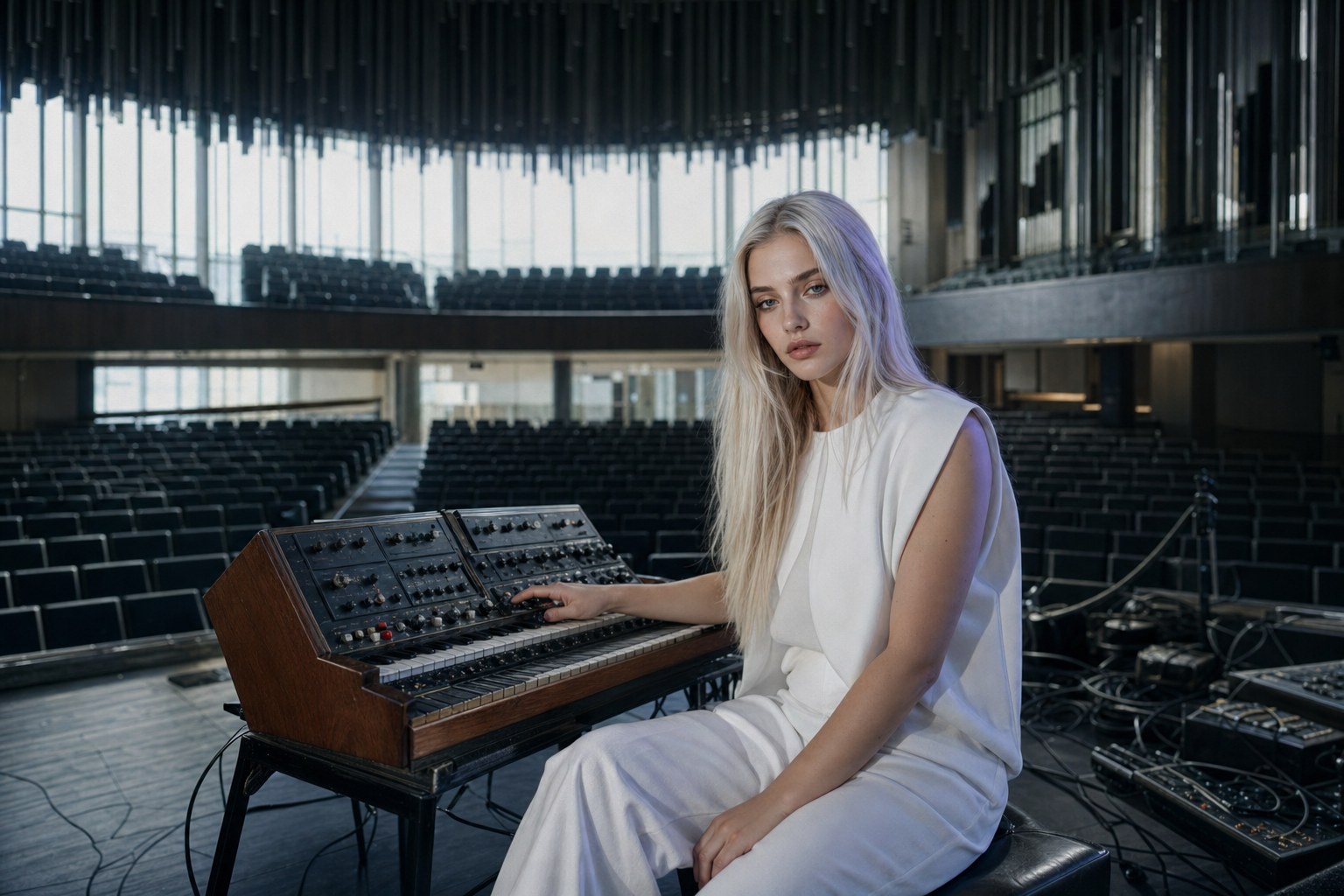
Solstice Light by Lyra Voss arrives as intentional restraint: the lead single Voltage (May 11, 2026) plants a single electric pulse that governs the record’s arcs. Lyra Voss frames the album’s sixteen tracks (released May 14, 2026) around that pulse, so the listener perceives a single heartbeat across both long- and short-form songs.
Solstice Light by Lyra Voss is a study in controlled expansion: across sixteen tracks released May 14, 2026, Lyra builds euphoric synth climaxes from narrow, almost modular elements—Voltage establishes the record’s 118 BPM four-on-the-floor groove and arpeggiated A-minor figure, and that same metric restraint returns in altered forms on at least nine other tracks, turning the album into a single-program listening experience.
Lyra Voss writes from Reykjavík’s particular quiet—the album’s tagline, "Aurora at midnight," isn’t metaphorical. Voltage opens with a Juno-like arpeggio, a clipped sidechain pump, and a vocal doubled with a clean octave-down layer; those textures are repeated and refracted across Solstice Light. The record favors small, high-contrast moves—slow filter opens, abrupt low-end drops—over maximalist walls of sound.
Solstice Light borrows lineage without mimicry: Lyra’s economy owes as much to The Knife’s clinical tension (Silent Shout, 2006) as to Robyn’s pop-architecture (Body Talk, 2010). Where The Knife used abrasive timbres and Robyn used kinetic tension, Lyra extracts tension through time—lengthening decay tails, inserting 3–4 second pockets of near-silence, and letting analog chorus bloom against a dry vocal center.
Solstice Light by Lyra Voss: the electric pulse and what it governs
Voltage sets the album’s governing pulse: a 118 BPM four-on-the-floor with a gated clap on the backbeat and a sub-bass that arrives only on the downbeats. That sub-bass is deliberately thin—sine-based rather than saw—so midrange arpeggios and vocal timbres occupy the listener’s emotional register instead of a heavy low end.
Lyra Voss treats the arpeggiator on Voltage as a motif rather than a hook: the A-minor arpeggio is transposed, filtered, and re-timed across the album so it sometimes appears as triplet figures or as a half-speed pad. This creates a sense of recurrent memory—the same gesture heard at 118 BPM, then ghosted at 59 BPM with long plate reverb—so the pulse feels both constant and liquefied.
Production choices reinforce that rule-bound feeling: Lyra uses short, bright convolution rooms on percussion for clarity, then layers long, unnatural plates on synths and vocals to simulate the stretched daylight of a solstice. The percussion rarely occupies the low-mid; instead, transient clicks and filtered white-noise hits carve space, which makes the euphoric synth swells feel like true arrivals.
Lyra Voss turns tempo into landscape: a single 118 BPM heartbeat lets small shifts—filter envelopes, vocal doubles, transient editing—do the heavy lifting of emotional motion.
Nordic synth-pop textures: vocal placement, reverb choices, and the art of absence
Lyra Voss places her voice in the dry center of mixes; on Voltage the lead vocal sits at roughly –6 dB LUFS against a chorus-heavy synth bed, with a narrow-band de-esser and a subtle 20 ms slap delay to thicken presence without pushing her into the reverb wash. When reverb does take over—most notably on the album’s mid-section ballad moments—Lyra switches to long, modulated plates that smear consonants and create that auroral shimmer.
The record leverages absence as a compositional tool: Lyra leaves long frequency gaps between 250–500 Hz across multiple tracks, which prevents muddiness and gives the higher harmonics room to bloom. That spectral sculpting is why euphoric synth peaks read as luminous rather than fat; they occupy the 1–5 kHz range with stereo widening, while the low mids stay intentionally hollow.
How to listen: three moves to hear the architecture
- Start with Voltage (track 1) at high volume to feel the 118 BPM pulse and the Juno-style arpeggio’s role.
- Jump to a mid-album track (around tracks 7–10) to hear how Lyra stretches the decay tails and flips the pulse into half-time.
- Listen on headphones to isolate the dry vocal center against the long plates: notice the 20 ms slap delay and octave-down doubling on intimate lines.
Solstice Light’s architecture is subtle but deliberate: by anchoring much of the album to the pulse of Voltage and by privileging spectral space over dense layering, Lyra Voss constructs a record that reads as one continuous piece. The twist is that the album feels simultaneously designed for the dancefloor and for late, reflective listening—light that both moves you and lets you stand in its glow.