
Santiago Fuego's Paraíso: 5 records to hear first
Santiago Fuego Paraíso doesn’t arrive as a single-club record. Its eighteen tracks move from rooftop dembow to balcony-after-midnight romance, so the best preparation is a short map of reggaeton’s melodic, tropical, and street-level lineages.
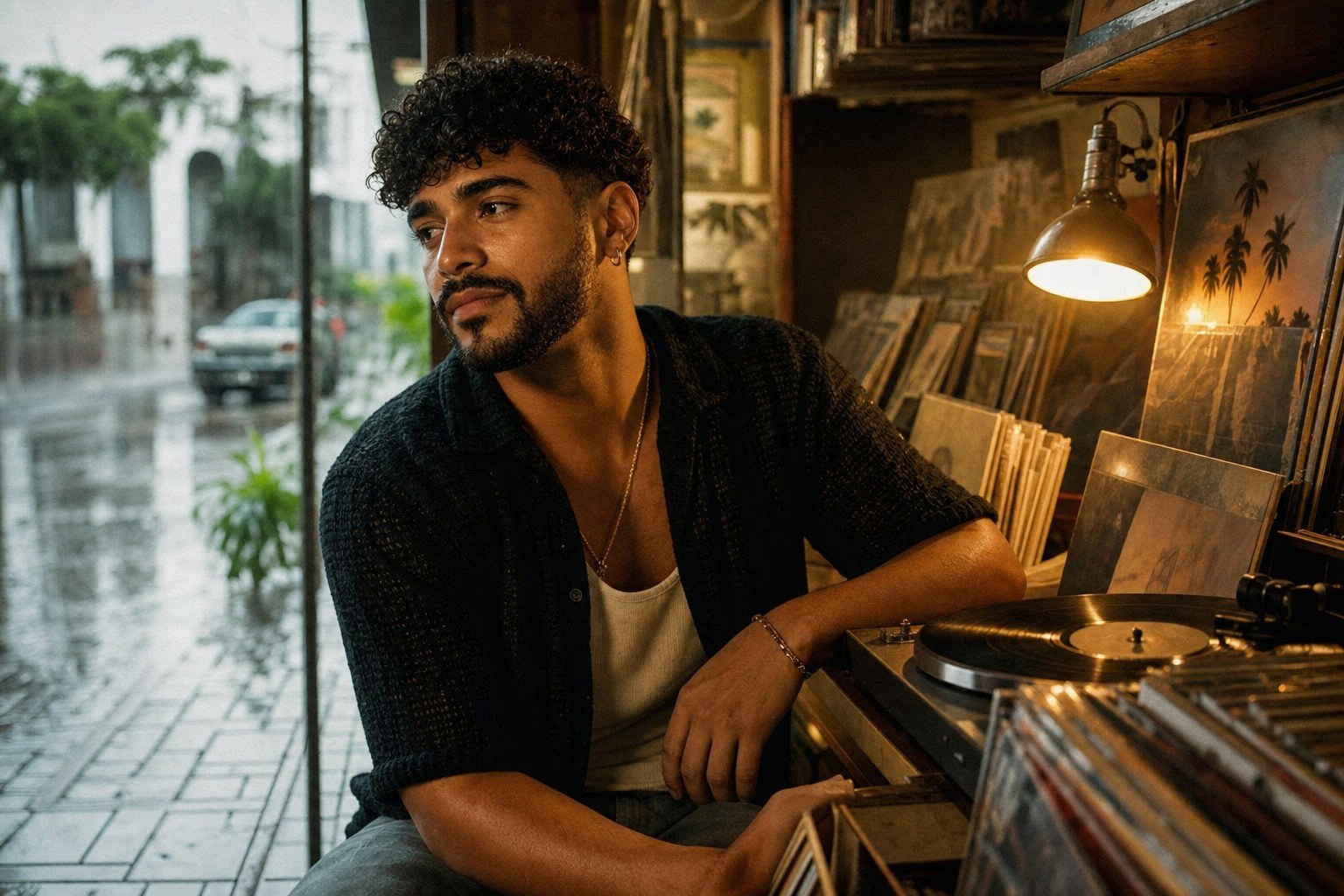
Santiago Fuego Paraíso is less a playlist of reggaeton modes than a full day rendered in rhythm: beach heat at noon, rooftop percussion at sunset, and a slower pulse after midnight. The record’s surprise is how comfortably its Spanish-first songwriting moves between dembow, Latin pop, tropical house, and salsa fusion.
The five best warmups for Santiago Fuego's Paraíso are Daddy Yankee's Barrio Fino (2004), Bad Bunny's YHLQMDLG (2020), J Balvin's Colores (2020), Rauw Alejandro's Vice Versa (2021), and Juan Luis Guerra's Bachata Rosa (1990). Together, they trace the album's 18-track route from hard dembow and melodic bass to tropical percussion, romantic phrasing, and Caribbean swing.
Paraíso arrived on May 5, 2026, three days after its lead single Vamos. Santiago Fuego's smooth tenor gives the album a flexible center: he can ride a rhythmic flow with clean Spanish articulation, then open into a hook without losing the unmistakable accent that places the voice inside the Caribbean rather than above it.
The album’s sequencing is its first argument. Vamos and Dale carry rooftop energy, while Caliente and Heaven slow the body without abandoning the dancefloor. La Noche and Paraíso turn toward late-night fire, making the record feel less like a collection of singles than one long social arc.
How to hear Santiago Fuego's Paraíso through five records
Start with the records that explain Paraíso's physical design. Santiago Fuego builds around the dembow rhythm, but the album's melodic bass and tropical percussion keep the groove open enough for Latin pop and tropical house. These aren't merely genre references; they clarify why a smooth tenor can carry both a rhythmic verse and a large, singable chorus.
The strongest comparison is structural rather than imitative. Daddy Yankee supplies the percussive command, Bad Bunny the willingness to make the album itself a volatile space, J Balvin the color-coded pop surface, Rauw Alejandro the romantic glide, and Juan Luis Guerra the older Caribbean intelligence beneath the gloss.
- Daddy Yankee — *Barrio Fino* (2004): Begin here for the blunt, bass-heavy authority of “Gasolina,” the clearest precedent for the direct dembow propulsion behind *Vamos* and *Dale*.
- Bad Bunny — *YHLQMDLG* (2020): Tainy's production and the album's abrupt shifts in beat, register, and attitude prepare you for Paraíso's movement between rhythmic flow, melodic hook, and late-night atmosphere.
- J Balvin — *Colores* (2020): Its color-titled sequence shows how a reggaeton album can use mood as architecture, a useful lens for the progression from the rooftop lift of “Vamos” to the slower heat of “Caliente.”
- Rauw Alejandro — *Vice Versa* (2021): “Todo de Ti” brings disco-funk brightness into Latin pop, while the album's romantic control points toward Santiago Fuego's smoother side on “Heaven.”
- Juan Luis Guerra — *Bachata Rosa* (1990): Guerra's supple guitar-led phrasing and polished tropical arrangements reveal the melodic Caribbean lineage beneath Paraíso's dembow and salsa-fusion surfaces.
Paraíso works because Santiago Fuego treats dembow as a spine, not a boundary.
The lineage behind the Spanish-language pop
Daddy Yankee's Barrio Fino is the necessary first stop because its 2004 impact came from compression: a hard rhythmic grid, a vocal built for repetition, and a chorus that behaves like a physical command. Santiago Fuego borrows the clarity of that design without narrowing the emotional palette. Vamos and Dale sound positioned for collective motion, but the album leaves room for desire and reflection.
Bad Bunny's YHLQMDLG matters for a different reason. Released in 2020, it made volatility feel native to the reggaeton album, with tracks that change energy before the listener settles into one mode. Paraíso is more linear and sunlit, yet its eighteen-track span uses a related principle: a dembow rhythm can support swagger, tenderness, celebration, or nocturnal tension depending on the vocal contour around it.
J Balvin's Colores and Rauw Alejandro's Vice Versa explain the crossover intelligence in Paraíso. Colores treats each track as a distinct chromatic room, while “Todo de Ti” turns a Latin-pop framework toward disco-funk. Santiago Fuego's tropical house and Latin-pop turns follow that same instinct for immediate atmosphere, with Spanish lyricism keeping the center of gravity local.
Juan Luis Guerra adds the deepest historical pressure. Bachata Rosa is not a dembow record, but its melodic patience and tropical orchestration show how Caribbean music can be intricate without becoming academic. That precedent sharpens the appeal of Caliente, Heaven, and the title track: their romance isn't an interruption to the rhythm; it's another way of inhabiting it.
A five-step listening path into Paraíso
- Play “Gasolina” before “Vamos” to hear the difference between dembow as command and dembow as invitation.
- Move from “Safaera” to “Dale” and listen for how each track uses rhythmic momentum to define personality.
- Pair J Balvin's “Rojo” with “Caliente” for two versions of romantic warmth inside a reggaeton album.
- Hear Rauw Alejandro's “Todo de Ti” before “Heaven” to catch the shared instinct for smooth, danceable release.
- Finish with “Bachata Rosa,” then return to “Paraíso” for the older tropical melody beneath the modern pulse.
The right preparation doesn't make Santiago Fuego's debut sound familiar. It makes its choices easier to hear. Paraíso understands the history of reggaeton, the polish of Spanish-language pop, and the emotional usefulness of tropical rhythm, then arranges them as a day that keeps changing light without changing its address.