
Modern Outlaw Country in 2026: Jesse Cole Beckett's porch songs
Modern outlaw country arrives less as a fashion and more as a set of domestic textures — a Telecaster bite at sunset, a slide steel sigh at the edge of a hymn. Jesse Cole Beckett's The Last Porch Light is the 2026 document that stitches those textures into sixteen songs of chapel-and-barroom economy.
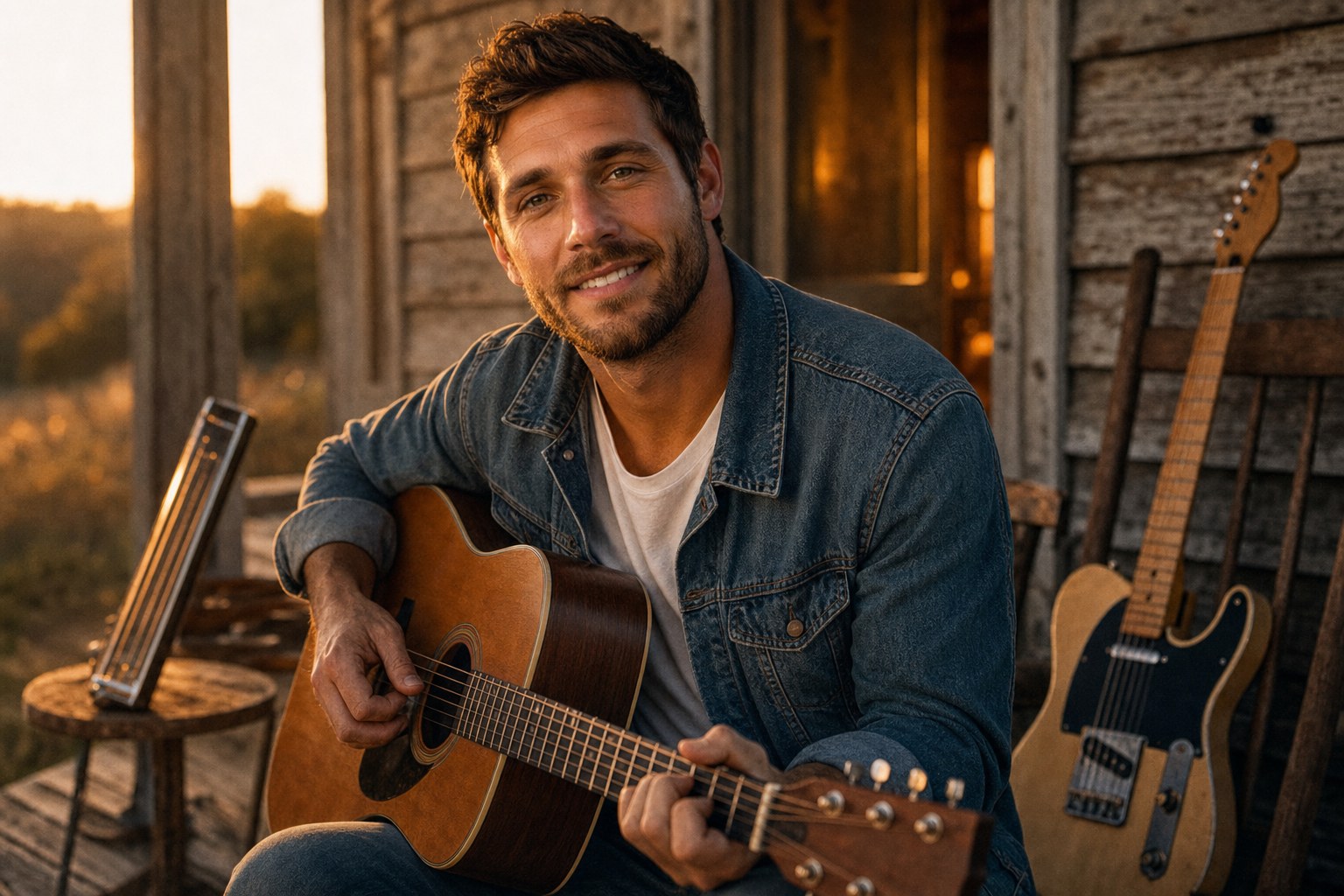
Modern outlaw country has a specific pulse in 2026, and Jesse Cole Beckett's The Last Porch Light presents it as a living room confession rather than a manifesto.
Jesse Cole Beckett's The Last Porch Light answers what modern outlaw country sounds like in 2026: sixteen tracks released May 8, 2026, that compress the Sturgill-Childers-Colter Wall lineage into songs built around acoustic guitars, slide steel, Telecaster accents, brushed drums and occasional church-piano lifts, favoring song shapes and baritone intimacy over studio gloss.
Jesse Cole Beckett's debut sequencing—opened by the single Good Trouble (May 5, 2026)—frames the record as a barroom-to-chapel arc. The Last Porch Light's Two Headstones and Hallelujah Anyway place narrative reckonings next to short refrains and choruses that resolve on root chords rather than maximal modulation.
Jesse Cole Beckett's voice is a warm baritone that leans conversational on verses and gruff on vamps; the production favors dry room reverb and midrange Telecaster bite so that the vocal sits just in front of the band, a choice that privileges lyric intelligibility and the old-country practice of text-first arranging.
modern outlaw country: origin and revival
Willie Nelson's Red Headed Stranger (1975) and Waylon Jennings' Honky Tonk Heroes (1973) mark the origin moment of outlaw country by stripping Nashville's orchestral slickness and foregrounding narrative austerity and artist autonomy.
Gram Parsons' Grievous Angel (1974) and Townes Van Zandt's self-revelatory songwriting in the early 1970s provided the emotional vocabulary—sparse arrangements, hurt delivered plainly—that outlaw artists later mined for authenticity cues.
Sturgill Simpson's Metamodern Sounds in Country Music (2014) and Tyler Childers' Purgatory (2017) catalyzed the 2010s revival, returning country to acoustic storytelling while allowing psychedelic textures and rock dynamics to seep into the production.
Sturgill Simpson's Metamodern Sounds in Country Music (2014) introduced modal harmonies and synth-tinged reverb into a country idiom; Tyler Childers' Purgatory (2017) reasserted Appalachian picking and organic room capture; Colter Wall's 2017 self-titled material revived stoic delivery and vintage recording spaces.
Jesse Cole Beckett's The Last Porch Light sits squarely in that revival: it borrows the sonic restraint of the 1970s outlaw records, the stylistic breadth of Simpson and Childers, and the baritone stoicism of Colter Wall—but it is distinguishable by its domestic imagery and chorus-first songwriting.
Jesse Cole Beckett treats outlaw country like a house with rooms—each song opens a door to a different domestic reckoning rather than a single theatrical stance.
what Jesse Cole Beckett adds to the lineage
Jesse Cole Beckett's The Last Porch Light emphasizes choruses as moral pivot points; tracks like Saturday Night Salvation and Hallelujah Anyway land on three- or four-note melodic hooks repeated with slight harmonic shifts rather than extended soloing or modulation.
Jesse Cole Beckett's arrangements favor tactile instrumentation: acoustic guitars fingerpicked in open tunings, slide steel set to a glassy tone around 9–11 on the amp's drive, brushed drums mixed to the side to mimic a saloon room, and the occasional church-piano lift that doubles the vocal at cadences.
Jesse Cole Beckett's production choices—short plate reverb, small-amp mic bleed, and Telecaster top-end around 3–5 kHz—keep the record near-field and intimate; this is modern country economy rather than the arena-ready compression that some contemporary country records favor.
listening close: three tracks
Jesse Cole Beckett's Good Trouble (single, May 5, 2026) opens with a Telecaster lick that repeats at the top of the verse and a ride-cymbal pattern that keeps time in 4/4 at a relaxed tempo—the effect is conversational urgency rather than momentum-driven propulsion.
Jesse Cole Beckett's Two Headstones pushes the album's narrative stakes; the slide steel doubles the vocal on refrains, creating sympathetic overtones that emphasize the song's third-inversion chord choices and a refrain that resolves on the tonic with a suspended fourth.
Jesse Cole Beckett's Hallelujah Anyway closes with a church-piano lift and handclap ghosting in the stereo field, gestures that align the song with country soul—rooted vocal delivery with a touch of gospel texture in the arrangement.
essential records — roots and revival
- Waylon Jennings — Honky Tonk Heroes (1973)
- Willie Nelson — Red Headed Stranger (1975)
- Gram Parsons — Grievous Angel (1974)
- Sturgill Simpson — Metamodern Sounds in Country Music (2014)
- Tyler Childers — Purgatory (2017)
- Colter Wall — Colter Wall (2017)
- Jason Isbell — Southeastern (2013)
Jesse Cole Beckett's selection of references is less about mimicry than lineage: he borrows Waylon's narrative austerity, Willie’s economical arrangements, Parsons' country-soul phrasing, Simpson's production curiosity, and Childers' Appalachian fingerprints, then compresses them into porch-scale songs.
Jesse Cole Beckett's hometown Coldwater, TN, threads through the record as place-specific detail—the Last Porch Light trades broad rural myth for named roads, sawmills and copper-still confessions that anchor the songs in local specificity.
Jesse Cole Beckett's baritone and the album's production make The Last Porch Light a record to listen to up-close: play it in headphones and you'll catch finger-noise on acoustic strings, the slide steel's fretharmonic ring, and vocal proximity—choices that reward repeat listens.
Jesse Cole Beckett's placement in the genre is as a craftsman of small-scale revelation; he does not transplant arena sonics into outlaw rhetoric but narrows the field to rooms and porches where the chorus does the moral work.
key takeaways
- Jesse Cole Beckett's The Last Porch Light (May 8, 2026) defines a porch-forward strand of modern outlaw country.
- Jesse Cole Beckett privileges chorus-first songwriting and intimate, dry production over arena-ready arrangements.
- Jesse Cole Beckett synthesizes classic outlaw austerity (Waylon, Willie) with revival-era textures (Sturgill, Childers).
Jesse Cole Beckett's The Last Porch Light restates what modern outlaw country can be: a genre that finds its force in domestic detail, baritone confession, and arrangements that honor the song's room. The new twist here is scale—the outlaw gesture shrunk to porch-light proportions, where the chorus, not the stadium, settles the score.