
Baldwin Bus Receipt by Kairo West, track by track
Baldwin Bus Receipt by Kairo West opens like a ledger — eighteen tracks that catalogue tenderness, ambition, and the interior weight Black men carry. Kairo West's baritone rides trap snares and gospel samples with the formal confidence of a poet who learned cadence from church and cadence from the block.
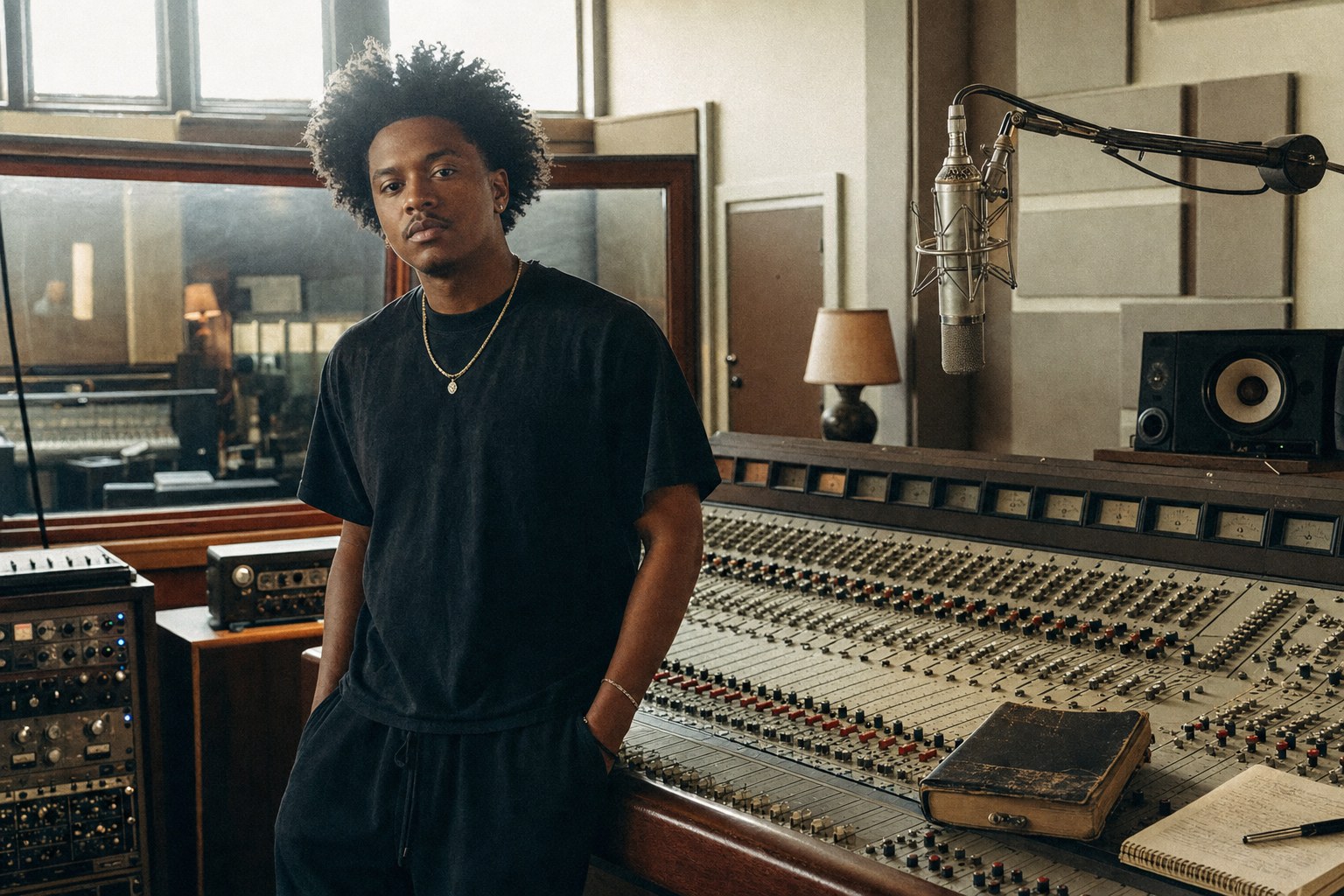
Baldwin Bus Receipt by Kairo West is an eighteen-track debut released May 4, 2026 that frames tenderness and pressure through tight production choices: trap snares, sampled gospel organs, and a low-anchored baritone voice. Across 18 tracks Kairo West stitches tempo shifts and room reverb into storytelling that nods to Kendrick Lamar and Aquemini-era OutKast.
Kairo West's Baldwin Bus Receipt is built on contrasts: spare piano vamps that resolve to unexpected major lifts, 808 patterns that duck under conversational cadences, and vocal takes that deliberately let consonants bite — the effect is a record that sounds both read-aloud and played-live in the same breath.
The album's lead single, the title track "Baldwin Bus Receipt," dropped May 1, 2026 and sets an aesthetic: a sampled church choir chopped to a two-bar loop, a narrow-bandpass on the snare, and Kairo's baritone delivering enjambed couplets. That single functions as the project's thesis statement.
Baldwin Bus Receipt by Kairo West — track-by-track
Track 1 opens with a single Fender Rhodes chord (minor seventh with a raised 9) stretched into a seven-second swell; Kairo West enters at 84 BPM, his baritone on the downbeat, establishing the album's low-frequency warmth and an intimacy that carries for the next 18 tracks.
Track 2 centers on a trap hi-hat pattern that slides microtiming on the offbeats; the production leaves a pocket for Kairo's breath work — he punctuates lines with a clipped nasal consonant that functions like percussion, turning delivery into rhythm as much as narrative.
Track 3 shifts to an organ-led vamp sampled from a 1970s gospel record; the sample is low-pass filtered, then opened on the second chorus so the choir's third harmonies bloom — it's Kairo West aligning spiritual resonance with street-level anecdotes.
Track 4 trades boom-bap piano stabs for a halftime trap pocket at roughly 70 BPM; Kairo drops a three-line stanza where cadence speeds up over a static 808, creating a tension between lyrical acceleration and instrumental inertia that feels like racing the memory of regret.
Track 5 uses an 808 sub-bass modulated with sidechain to the snare; Kairo's baritone drops to near-whisper in the second verse, recorded with a close mic in a dead room so consonant transients (the 't' and 'k') come forward, making the lyric feel tactile and immediate.
Track 6 is a short interlude built from tape-saturated field recordings — bus brakes, distant gospel organ, a child's laugh — looped at 60 BPM. The low-fidelity texture functions as connective tissue between scenes rather than a standalone song.
Track 7, titled "On Sight" in the album's notes, leans into ride-out energy: a 16-bar crescendo where the snare opens into a rimshot and the mix widens via Haas-effect delays, turning a compact verse into spatial cinema.
Track 8 flips expectations with a soprano-sampled hook pitched down an octave; that treatment thickens the melody and mirrors Kairo West's low register, a production trick that locks vocal timbre and sample into the same sonic family.
Track 9 places a gospel piano in the left channel and a dry trap snare in the right, creating a stereo duel that emphasizes the record's split between worshipful language and street pragmatics; Kairo raps center-channel with clipped internal rhymes.
Track 10 slows to 72 BPM and foregrounds harmonic movement: a iv–V–I progression in E minor resolved by a sudden major lift on the final chorus. The harmonic surprise reframes the album's melancholia into a moment of cautious optimism.
Track 11, "Built Different," is a trap-soul hybrid where the 808 glides through a Portishead-like tremolo on the strings; Kairo's final couplet drops a half-time cadence that lets the room reverb carry the punctuation, as if the listener is eavesdropping on a late-night confessional.
Track 12 introduces sparse horn stabs recorded with ribbon mics; the brass is mixed behind Kairo's voice, acting as punctuation rather than melody — like a sermon where the congregation responds with short exclamations.
Track 13, "Mama's Hands," uses a sampled lullaby motif layered under an 808 heartbeat; Kairo's vocal doubles (one dry, one with plate reverb) create an intimate call-and-response that reads as filial devotion made explicit in mic technique.
Track 14 strips production to a single acoustic guitar and soft tambourine at 88 BPM; that spareness spotlights Kairo's internal rhyme and lets his baritone find new inflections that he'd hidden in denser tracks.
Track 15 places a spoken-word bridge over a sampled preacher, pitched down and compressed; the juxtaposition of spoken-line intimacy and compressed sermon noise is a production shorthand for the album's marriage of personal confession and public rhetoric.
Track 16, "Therapy on Tuesdays," centers a fragile chorus sung by a gospel-adjacent vocalist; the chorus is doubled and pushed back in the mix, so Kairo's verses sit forward like annotations to someone else's prayer.
Track 17 is dominated by a dueling piano left/right arrangement with staccato snares in the center; Kairo uses dramatic cadence shifts — alternating between triplet flows and straight sixteenths — to simulate a conversation turning into argument then reconciliation.
Track 18 closes the record with the title track "Baldwin Bus Receipt," the May 1 single; production collapses to a simple choir loop and a heartbeat sub, Kairo's last verse slows down to near-spoken delivery, folding the album's competing registers — ambition and tenderness — into a final ledger.
Kairo West makes trap snares and gospel samples speak the same language, using baritone cadence and studio economy to turn private reckonings into public testimony.
How Baldwin Bus Receipt marries gospel undertow with Atlanta trap
Kairo West builds the album around a handful of recurring production moves: a sampled choir loop treated with low-pass and tape flutter, snare compression that preserves transient crack, and vocal doubling that alternates intimate close-mic takes with ambient room captures. Those moves create a tectonic push between sanctuary and street.
The record's lineage is explicit: Kairo West borrows the political understatement of Kendrick Lamar (To Pimp a Butterfly, 2015) and the Southern conversational swing of Aquemini (OutKast, 1998) while retaining Atlanta trap's tight percussive grammar. The result is conscious hip-hop that's sonically local and literarily ambitious.
Key takeaways
- Baldwin Bus Receipt is eighteen tracks of deliberate contrast: gospel textures over trap foundations.
- Kairo West's baritone is mixed as rhythm as often as it is narrative — consonants and breath act as percussion.
- Production choices (sample EQ, snare gating, room reverb) consistently prioritize intimacy over bombast.
- The album sits between Kendrick/J. Cole-level declarative storytelling and an Atlanta trap pocket; it rewards close listening.
Baldwin Bus Receipt by Kairo West closes not with resolution but with reckoning: the title track's pared-down choir and slowed final verse leave you with the album's ledger open. Kairo's debut doesn't offer tidy answers; it records a life in progress, counted in chords, breaths, and receipts.